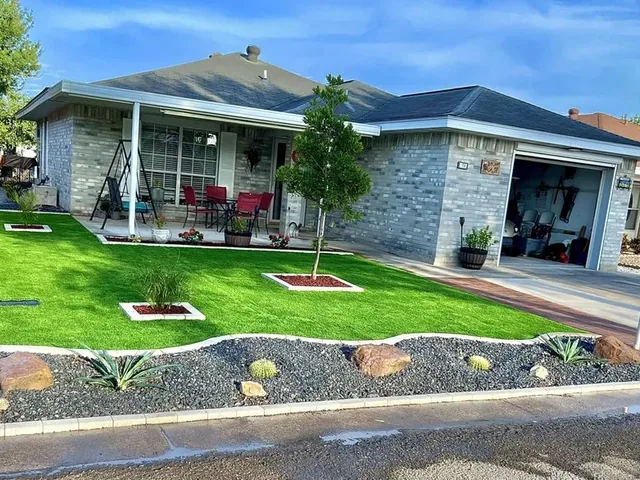
Landscaping
The whole property, handled as one job.
Beds, borders, planting and grade, sequenced so nothing gets torn up twice.
The seams are where yards go wrong.
Three separate contractors will each do their part correctly and still leave you with a bad result. The paving crew cuts an irrigation line nobody told them about, the planting goes in before the grade is finished, and the mulch washes across the new path the first time it rains.
Doing it as one job is not about convenience. It is about somebody owning the order the work happens in.
What a whole-property job includes
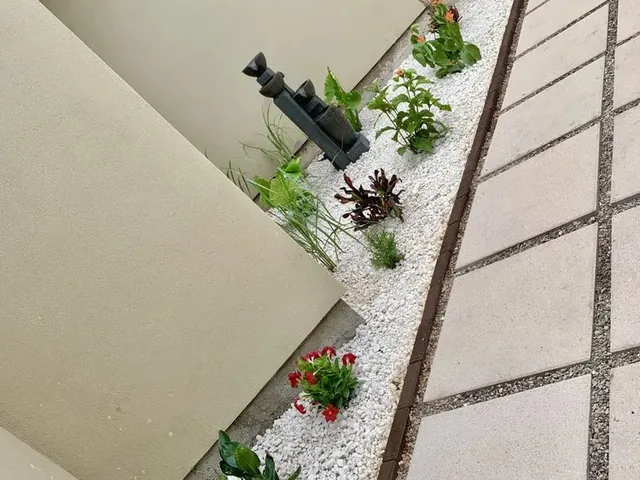
- Grading and shaping before anything is planted
- Stone, boulder and cut-paver bed borders
- Rock, mulch and decomposed granite to depth
- Planting positioned for mature size, not for today
The order it has to happen in
Change this sequence and something gets dug up twice.
- 01Clear and gradeEverything that is leaving, leaves. Then the ground is shaped while machines can still reach it.
- 02Drainage and sleevesFalls set, and pipe run under anything that will later be hard surface.
- 03Hard edgesBorders and paving define the beds, so the planting has something to be laid against.
- 04Soil and plantingTopsoil to depth, then plants, then the mulch or rock that holds it all down.
Questions people actually ask
Can it be done in phases?
Yes, and it often should be. The requirement is that the drawing covers the whole property even if the build does not, so phase two does not undo phase one.
Do you take away what is there now?
Clearing, spreading and leveling with heavy machinery is on the service list, so removal is part of the same job rather than something you arrange separately.
What about the plants already growing well?
They stay if they are in the right place. Established shade is the one thing a new landscape cannot buy.
Turf & Grass
Green in July, without the water bill.
Artificial turf where the sun wins, natural grass where it doesn't.
Green in July is the whole question.
In the Valley a lawn either gets watered properly or it turns. Artificial turf takes that decision away, and it is why turf appears in more of JAAB’s photographs than almost anything else: bordered panels in front yards, around pools, and inside play areas.
Natural grass is still the right answer on plenty of properties. It is on the same service list, and the honest version of this page says when it wins.
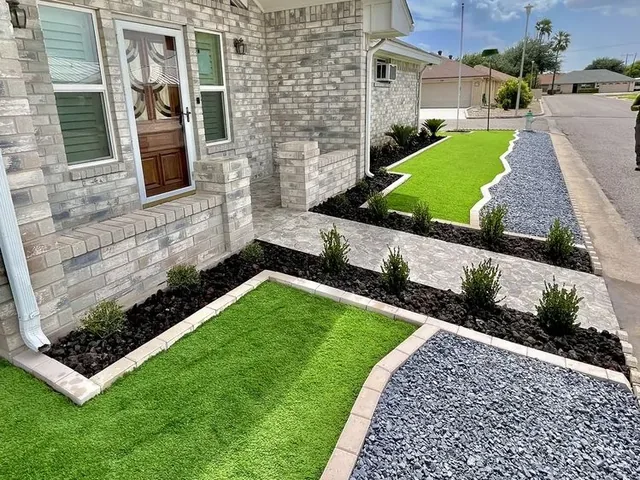
What a turf panel actually involves
- Excavation and a compacted base, because turf over soil moves
- A hard border so the edge cannot lift or creep
- Cut-outs left square around trees and features
- Seams placed away from the sightline from the house
Artificial turf or natural grass
Both are on the list. This is the trade, honestly stated.
Artificial turf
- Green through the whole summer
- No mowing, feeding or reseeding
- Takes shade where grass gives up
- Holds a crisp edge against paving
- Costs more to install than seed or sod
- Gets noticeably hot in direct afternoon sun
- Needs rinsing and brushing, not nothing
- Cannot be repaired invisibly once seamed
Natural grass
- Cooler underfoot on a hot day
- Cheaper to put down
- Repairs itself given water and time
- Handles a large area affordably
- Wants water on a schedule, not on a whim
- Thins out under heavy shade
- Mowing and feeding never stop
- Goes off color in the worst of the heat
Both, split
- Turf where it is looked at and walked on
- Grass on the open areas where cost scales
- Beds and rock absorb the awkward corners
- Two edge details rather than one
- The join has to be designed, not improvised
Solid marks are the case for it, gray marks the cost of it. Both are real; which one wins depends on the property.
Questions people actually ask
How hot does turf get?
Hot enough to notice barefoot in full afternoon sun. Shade, a rinse, or lighter-colored blends all help; nothing makes it as cool as grass.
Can turf go over the existing lawn?
No. Laid over soil it ripples and holds water. It needs the soil out and a compacted base in, which is most of the work.
Do dogs ruin it?
No, but drainage under it stops it holding odour. That is a base decision, taken before the turf ever arrives.
Irrigation
The plants don't fail. The watering does.
Irrigation systems and solar sprinklers, zoned to what is actually planted.
Plants rarely fail. The watering does.
One zone covering a lawn, a bed of shrubs and a row of pots guarantees that something is always wrong. Grass wants a lot of water quickly; established shrubs want less, slowly and deeper. Run them together and you either drown the beds or starve the lawn.
Splitting the zones by what is planted, not by which corner of the property it is in, is most of the design.
How a system is laid out
- Zones split by planting type and by sun exposure
- Heads matched for precipitation rate within a zone
- Sleeves under every present or future hard surface
- Valve boxes and the controller left reachable
Is your watering the problem?
Tick anything you recognize. This counts what you ticked. It does not diagnose the system.
Questions people actually ask
What are solar sprinklers?
Solar-powered controllers and valves, so a zone can be added where running mains power to a controller would be the expensive part of the job. They are on JAAB’s service list.
Can zones be added later?
Yes, if there is capacity and pressure. That is why the pressure test happens before the head count is fixed rather than after.
Do I need drip or sprays?
Beds usually want drip: water at the root, nothing on the leaves. Lawn wants sprays or rotors. Most properties end up with both, on separate zones.
Water Features
Something to listen to, not just look at.
Fountains and pumps, set into rock work rather than dropped on a slab.
Something to listen to, not just look at.
A fountain does a job no plant can: it puts a sound over the road and the neighbors. That is most of the reason people want one, and it is why placement matters more than the feature itself. Close enough to the seating to be heard, far enough that it is not the only thing you can hear.
The part that decides whether it still works in three years is all underneath: the pump, the reservoir and the power, run before the stone goes down.
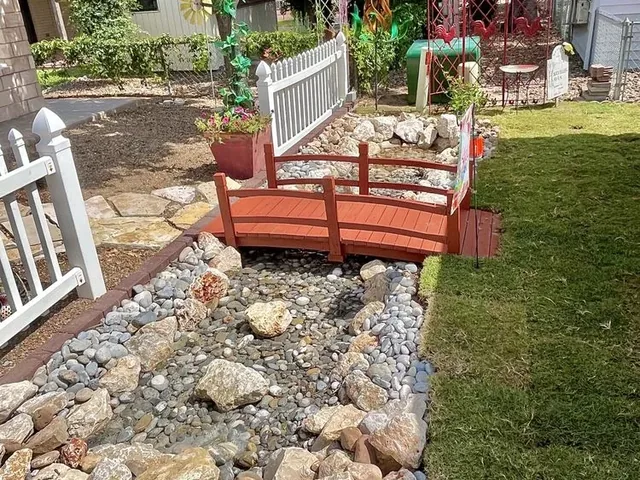
What sits under a water feature
- Reservoir sized so the pump never runs dry
- Power run and sleeved before any stone is set
- Access to the pump without dismantling the feature
- Rock and planting built around it, not dropped near it
Where would it go?
Tick what is true of the spot you have in mind.
Questions people actually ask
How much upkeep is it?
Topping up in summer, and clearing debris out of the reservoir, more often under trees. A pump that is easy to reach is the difference between a small job and an ignored one.
Is it safe with young children?
A pebble or disappearing feature has no standing water, which is why it is the usual answer where small children use the yard. Basins and ponds are a different conversation.
Can it be added to an existing bed?
Yes, but the power and reservoir still have to get there, so some of the bed comes up. Cheaper to build in than to retrofit.
Lawns & Planting
The green side, and the water that keeps it that way. Send photos of the space and someone will come and look at it.