Driveway Pavers
The first thing anyone sees, and the last thing most people fix.
Modern paver and brick driveways, laid to a pattern that carries a vehicle.
A driveway is a structure, not a surface.
It carries a vehicle several times a day, every day, and almost every driveway failure traces back to what was underneath rather than what was laid on top. Depth and compaction come from the ground that is actually there, not from a standard build-up.
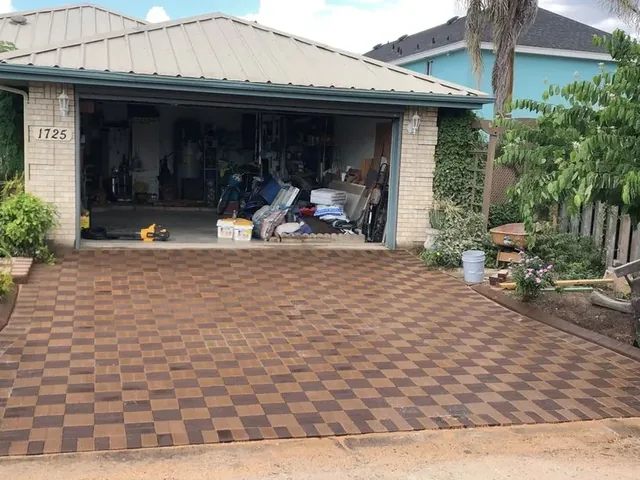
The pattern matters too, and not only for looks. How the units interlock is what decides whether the field creeps where the wheels turn.
What goes into it
- Excavation to a depth set by the ground, not by habit
- Sub-base compacted in layers rather than in one pass
- Edge restraint before the field is laid, never after
- Banded or contrasting borders to hold the eye and the edge
Laying patterns
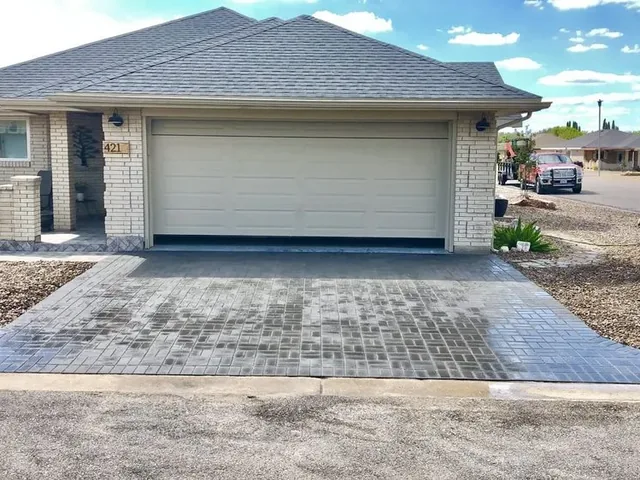
All four are in JAAB’s own photographs. The choice changes both the look and how the surface behaves under a turning wheel.
Units lock against each other in two directions, which is why it is the pattern that goes down where vehicles turn and brake. The most work to cut in at the edges, and the most stable once it is there.
Questions people actually ask
Pavers or poured concrete?
Pavers can be lifted and relaid if a service has to be reached or a corner settles. Concrete is one piece: cheaper to place, and a repair is always visible. Both are on the list.
Will weeds come up through the joints?
Joints are filled with sand rather than left open. Anything that grows there arrived from above, which is a sweeping problem rather than a build problem.
Can you match an existing drive?
Sometimes. Unit colors run in batches and older stock fades, so an exact match is rare. A deliberate contrasting band usually reads better than a near-miss.
Patio Pavers
Stop looking at the backyard. Start living in it.
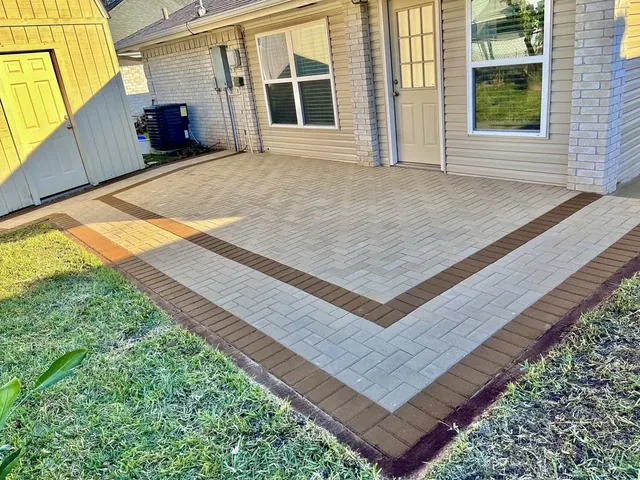
Paver and brick floors, squared to the space and edged so they hold.
Size it around the furniture, not the wall.
The most common thing wrong with a patio is that it is exactly as big as the space that was available. Chairs pull out roughly two feet from the table, and if that runs off the edge, everyone sits with one leg on the grass and the patio quietly stops being used.
Squaring it to the fence line, running it out to where people actually stand, and edging it so it holds its shape is most of the job.
How it gets built
- Set out around how the space is used, then squared to the house
- Large-format units with open joints, or tight brick-sized
- A border band that contains the field and hides the cuts
- Falls run away from the building, never towards it
Unit size and layout
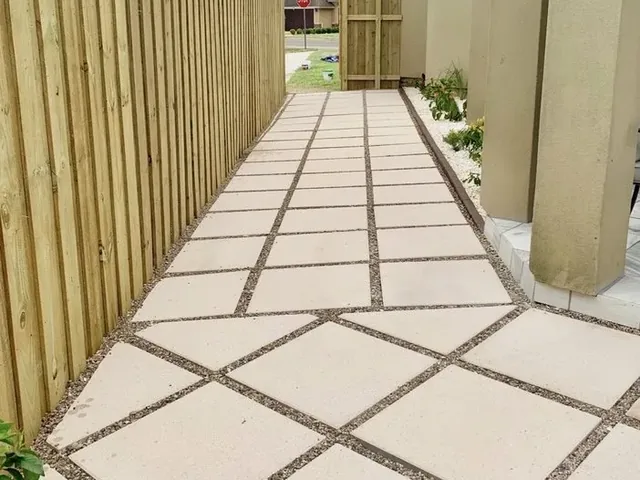
The same area reads completely differently depending on unit size. Both of these are in their photographs.
Big square units with wide open joints. Fewer lines means the space reads larger and calmer, and it is quick to lay, but every unit has to sit dead level, because a big slab shows a rock that a small one would not.
Questions people actually ask
How big should it be?
A four-seat table needs roughly 12ft by 12ft before anyone is on the grass. Add for a grill, a bench run, or anywhere people stand rather than sit.
Can a patio go over an existing slab?
Sometimes, if the slab is sound and the extra height does not foul a door threshold. Both are things to check on site rather than assume.
Travertine or pavers?
Travertine stays cooler underfoot and looks better wet, which matters around a pool. Pavers take more abuse. There is a page for travertine and tile as well.
Travertine & Tile
The finish that decides how the whole thing reads.
Travertine and tile, laid where the surface is going to be looked at closely.
This is the finish people look at closely.
Travertine and tile go where feet are bare and eyes are close: pool surrounds, entryways, the strip between the door and the table. At that distance a joint that wanders by a few millimeters is visible, and a lippage between two units is something you feel before you see.
The material is the easy part. Flat, square and consistent is the part that takes time.
Where it goes and how
- Pool decks and coping, where cool underfoot matters
- Patios and entryways under close inspection
- Cut edges rather than a border of slivers
- Falls held while the surface stays visually level
Tone and finish
Color changes how hot a surface gets in a Valley summer as much as how it looks.
The palest and the coolest underfoot, which is why it turns up around pools. It shows leaf stain and iron more than the darker tones, so it wants sealing and rinsing.
Questions people actually ask
Does travertine need sealing?
It is porous, so it takes on stain and iron if it is left bare. Sealing is normal rather than optional, and it is not permanent.
Is it slippery around a pool?
Tumbled and brushed finishes have grip when wet, which is why they are used at pool edges. A polished finish belongs indoors.
Can tile go outside here?
Porcelain can, if it is rated for it and laid on a base that will not move. Standard indoor tile on an unstable base will crack at the joints.
Concrete
Poured flat, finished properly, colored if you want it.
Pouring, plus granite grip, acid stain and epoxy over what is already there.
Poured is one afternoon. The rest is the job.
Forming, base and finish take far longer than the pour and decide everything about how the slab behaves. Concrete will crack. The only question is whether it cracks at a joint somebody cut on purpose or across the middle where nobody wanted it.
Painted finishes are the other half of this page. Granite grip, acid stain and epoxy all go over concrete you already have, which makes them the cheapest way to change a surface without replacing it.
Pouring and finishing
- Formed and reinforced before anything is ordered
- Control joints cut to a plan, not where it looks tidy
- Broom, float or stamped finish decided before the pour
- Color applied through the mix or onto the surface after
Painted concrete finishes
All three named finishes are on JAAB’s own service list. Each behaves differently underfoot and in sun.
Plain concrete, textured with a broom while it is still green. Grip comes from the texture, it costs the least, and it is the honest baseline the other finishes go over.
Questions people actually ask
Will it crack?
Yes. Concrete moves as it cures and with temperature. Control joints decide where that shows, which is why they are cut to a plan rather than to taste.
Can you stain concrete that is already down?
Usually. That is the whole point of the painted finishes: they change a surface without replacing it. A slab that is spalling or moving needs fixing first.
Stamped concrete or pavers?
Stamped is cheaper and continuous. Pavers can be lifted and relaid. If something is ever going under that surface, pavers save you twice.
Paving & Stone
What you drive on, walk on and put the furniture on. Send photos of the space and someone will come and look at it.